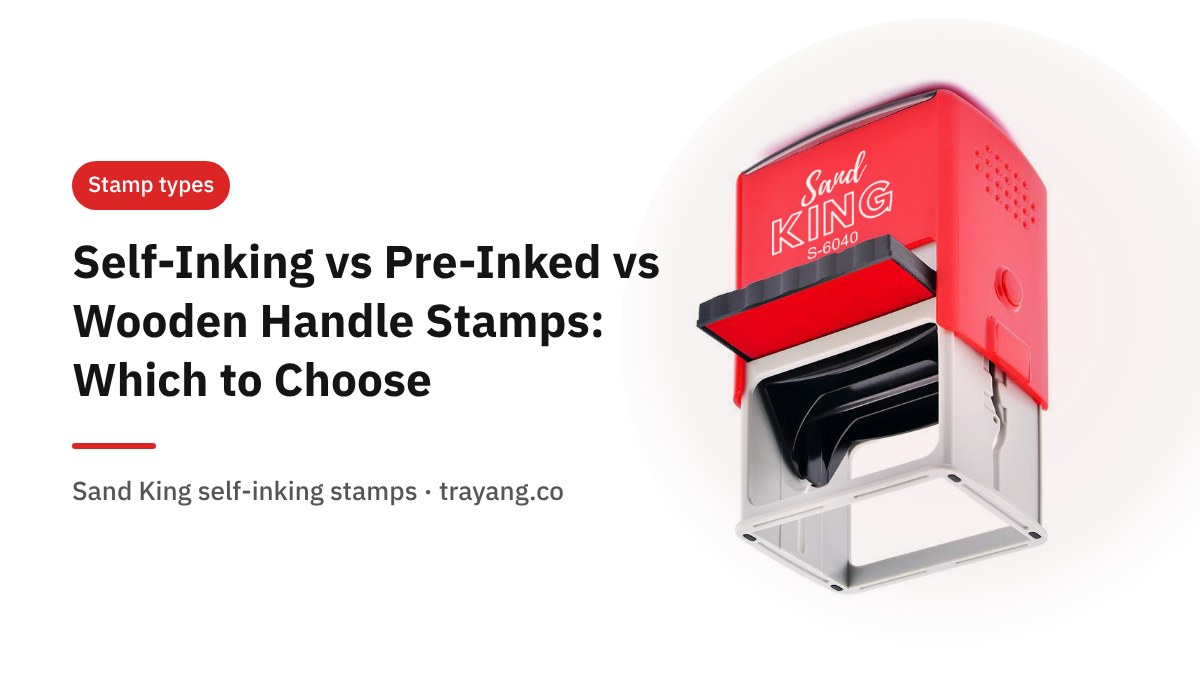
A self-inking stamp has a built-in ink pad and flips the rubber onto it every time you press; a pre-inked (flash) stamp holds ink inside the stamp face itself; a wooden or classic handle stamp is pressed onto a separate ink pad. Choose self-inking for daily office use, a classic handle for the lowest price or easy colour changes, and ask about pre-inked when you want no pad and no moving parts.
All three put the same wording or logo on paper. The difference is how the ink gets to the rubber, which changes the price, the speed and how much mess you live with.
How each type works
Self-inking stamps
The rubber sits inside a plastic or metal housing with an ink pad above it. When you press down, a spring mechanism flips the rubber, it leaves an impression, and it returns to the pad to re-ink. You never touch an ink pad. Brands include Trodat and Shiny, and we also make self-inking stamps in many sizes from our own list. See our self-inking stamps page.
Pre-inked (flash) stamps
A pre-inked stamp, called a flash stamp in Thailand, has ink soaked into the stamp face itself. You press it straight onto paper with no separate pad and no flipping mechanism. We make flash stamps with text, names, addresses or logos and quote the price for each design. Note that "flash stamp" is the stamp type; it has nothing to do with the Flash courier we use for deliveries.
Wooden or classic handle stamps
The rubber is mounted on a handle and you press it on an ink pad before every impression. It is the simplest and cheapest design, and changing ink colour is as easy as changing the pad.
Side-by-side comparison
| Self-inking | Pre-inked (flash) | Classic handle | |
|---|---|---|---|
| Ink source | Built-in pad in the housing | Ink inside the stamp face | Separate ink pad |
| Speed | Fast, press and lift | Fast, press and lift | Slower, ink every press |
| Changing ink colour | Replace the ink cartridge | Ask us when ordering | Change the pad |
| Starting price (our list) | From THB 200 | Quoted per design | From THB 150 |
| Best for | Offices stamping daily | Clean, pad-free use | Low budget, occasional use, colour changes |
Price examples for the same size
From our shop list, for a finished stamp with your own wording:
| Size (mm) | Self-inking | Classic handle |
|---|---|---|
| 20 x 20 | THB 400 | THB 200 |
| 25 x 25 | THB 450 | THB 250 |
| 30 x 30 | THB 500 | THB 300 |
| 70 x 25 | THB 600 | THB 300 |
| Round R30 | THB 600 | THB 300 |
| Round R50 | THB 800 | THB 500 |
The self-inking price includes the housing and the built-in pad, which is why it costs more than a classic stamp of the same size. Full lists are on our rubber stamp prices page.
Which one should you choose?
- You stamp invoices, receipts or documents every day: self-inking. It is quick and keeps desks clean.
- You stamp now and then, or want several ink colours: classic handle with a pad in each colour you need.
- You want no pad and no moving parts: ask us about a pre-inked flash stamp for your design.
- You need a date that changes every day: a date stamp. See how to choose a date stamp.
- Large logos or big formats: classic handle sizes go up to 90 x 50 mm on our list; bigger special sizes are quoted.
What about stamping plastic, glass or packaging?
Standard black, blue and red inks are made for paper. Smooth surfaces like plastic bags, glass and clear tape need special ink, and no single ink works on every surface. Send a photo of the material on LINE and we tell you what is possible and any limits before you order. Special inks are quoted separately.
Care and running costs
Running costs differ more than the purchase price suggests.
- Self-inking: when impressions get evenly lighter, refill the pad with ink of the same colour, or replace the cartridge if the pad has gone hard. See how to refill a self-inking stamp.
- Classic handle: the rubber itself lasts; you re-ink or replace the separate pad. One pad can serve several stamps of the same colour.
- Pre-inked: ask us how to re-ink your particular flash stamp when you order.
For all three, store the stamp flat, out of direct sun and heat, and wipe paper dust off the rubber now and then.
Mixing types in one office
Many offices combine them: self-inking stamps for the words used every day, such as RECEIVED or PAID, and a classic handle stamp with a pad for a large logo or something used once a month. You do not have to choose one type for everything. Tell us the list of stamps you need and how often each is used, and we suggest the type for each one.
Frequently asked questions
Is a self-inking stamp the same as a pre-inked stamp?
No. A self-inking stamp re-inks from a pad inside the housing; a pre-inked stamp holds the ink in the stamp face.
Can I refill a self-inking stamp?
Yes, with ink of the same colour and type. See how to refill a self-inking stamp.
Which is cheapest?
The classic handle stamp, from THB 150 on our list.
Can I order just one?
Yes. There is no minimum order.
Not sure which type fits? Tell us what you stamp and how often on LINE @trayang.th and we recommend one, with a proof before production.