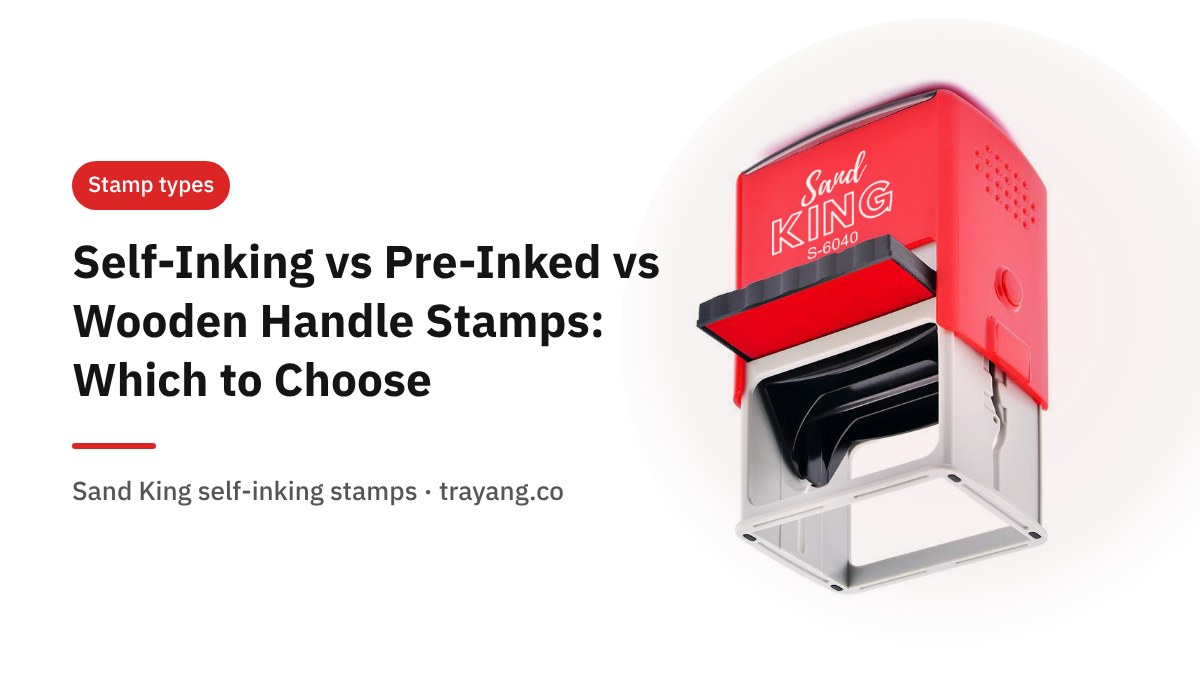
A self-inking stamp has a built-in ink pad and flips the rubber onto it every time you press; a pre-inked stamp holds ink inside the stamp face itself; a wooden or classic handle stamp is pressed onto a separate ink pad. Choose self-inking for everyday use, a handle stamp for the lowest price, large sizes or special inks, and a pre-inked stamp when you want no pad at all.
All three put the same wording or logo on paper. The difference is how the ink reaches the rubber, which changes the price, the speed and how much mess you live with.
How each type works
Self-inking stamps
The rubber sits inside a plastic housing with an ink pad above it. When you press down, a spring flips the rubber onto the paper and back up to the pad to re-ink. You never touch an ink pad, so it is quick and clean. This is the type most people mean by "custom stamp" today.
Pre-inked stamps
A pre-inked stamp has ink soaked into a porous stamp face. You press it straight onto paper with no pad and no flipping mechanism. Impressions are sharp, and the stamp is re-inked by dripping ink into the face itself. Trayang Global does not make pre-inked stamps; we make self-inking and handle stamps.
Wooden or classic handle stamps
The rubber is mounted on a handle and you press it on an ink pad before each impression. It is the simplest design, it comes in the widest range of sizes, and changing ink is as easy as changing the pad.
Side-by-side comparison
| Self-inking | Pre-inked | Handle | |
|---|---|---|---|
| Ink source | Built-in pad | Ink inside the stamp face | Separate ink pad |
| Speed | Fast: press and lift | Fast: press and lift | Slower: ink every press |
| Mess | Very little | Very little | A pad on the desk |
| Changing ink | Refill or change the pad | Re-ink the face | Use another pad |
| Special inks (plastic, fabric) | Not usually | Not usually | Yes, with a solvent pad |
| Best for | Daily office and packaging use | Sharp, pad-free impressions | Low budget, big sizes, special surfaces |
Price examples for the same size
From the Trayang Global list, for a finished stamp with your own wording or logo:
| Size | Self-inking | Handle |
|---|---|---|
| 20 x 20 mm (0.79 x 0.79 in) | $15.90 | $12.90 |
| 25 x 25 mm (0.98 x 0.98 in) | $15.90 | $12.90 |
| 30 x 30 mm (1.18 x 1.18 in) | $18.90 | $12.90 |
| 70 x 25 mm (2.76 x 0.98 in) | $25.90 | $19.90 |
| Round 30 mm (1.18 in) | $18.90 | $14.90 |
| Round 50 mm (1.97 in) | $31.90 | $18.90 |
The self-inking price includes the housing and built-in pad, which is why it costs more than a handle stamp of the same size. Handle stamps also go larger, up to 90 x 50 mm (3.54 x 1.97 in) and round 70 mm (2.76 in) on our list.
Prices are from the Trayang Global price list in November 2026. The price shown in the studio when you add a stamp to your cart is the one you pay; shipping is quoted for your country before you pay.
Which one should you choose?
- You stamp invoices, mail or packaging every day: self-inking. It is quick and keeps desks clean.
- You stamp now and then, or want the lowest price: a handle stamp with a pad.
- You stamp plastic bags, fabric or other non-paper surfaces: a handle stamp with a solvent ink pad.
- You want a large logo: a handle stamp, which comes in bigger sizes.
Ink colours and special surfaces
Self-inking stamps from Trayang Global can be ordered with blue (the default), red, black, green, purple, orange, pink, light blue, yellow or brown ink, or with no ink if you have your own. Standard stamp-pad ink is made for paper and card. For plastic, fabric and most other surfaces, choose a handle stamp and add a StazOn solvent ink pad ($18). The StazOn pad is sold for handle stamps.
Care and running costs
- Self-inking: when impressions get evenly lighter, add refill ink of the same colour. A 28 ml refill bottle is $7. See how to refill a self-inking stamp.
- Handle: the rubber itself lasts; you re-ink or replace the separate pad, and one pad serves several stamps of the same colour.
- Pre-inked: re-ink with the ink the maker recommends; other inks can clog the face.
For all three, store the stamp flat, out of direct sun, and wipe paper dust off the rubber now and then.
Mixing types
Many offices and shops combine them: self-inking stamps for words used every day, such as RECEIVED or PAID, and a handle stamp with a solvent pad for logos on bags and boxes. You do not have to choose one type for everything.
Ready to make one? Design your stamp online and see the real-size impression before you add it to your cart, or browse ready-made stamps.